
Women in Aviation
Barbara Harmer (1953–2011)

The Concorde, the supersonic airliner landing in Ben Gurion Airport" by the National Library of Israel, via Wikimedia Commons. Licensed under CC BY 4.0. Image modified: cropped for size.
Barbara Harmer left school at 15 to become a hairdresser. Odd sentence for a story about women in aviation, right? Within five years, however, she made the unexpected change to air traffic control training, eventually becoming a controller at London’s Gatwick Airport. Concurrent with that training, Harmer restarted her formal education and took out a loan to pay for flying school.
Harmer earned her private pilot license, became a flight instructor, and, in 1982, obtained a commercial pilot license. After sending out more than a hundred applications she was hired by short‑lived commuter air carrier Genair, where she flew Short 330 turboprops. Harmer’s career continued with British Caledonian, flying British Aircraft Corporation (BAC) One‑Elevens, and eventually transitioned to the McDonnell Douglas DC–10.
In 1987, British Caledonian merged with British Airways, and Harmer entered a pool of over 3,000 pilots, only 60 of whom were women. Five years into her employment at BA, Harmer entered specialized training that qualified her for the supersonic Concorde. In 1993, Harmer flew as first officer on a Concorde flight—a first for a woman pilot. She flew Concorde until it was removed from service in 2003; after that Harmer flew Boeing 777s until her retirement in 2009.
Only two other women flew Concorde: test pilot Jacqueline Auriol was the first to fly it, and Béatrice Vialle of Air France also flew it in service.
Geraldine Mock (1925–2014)
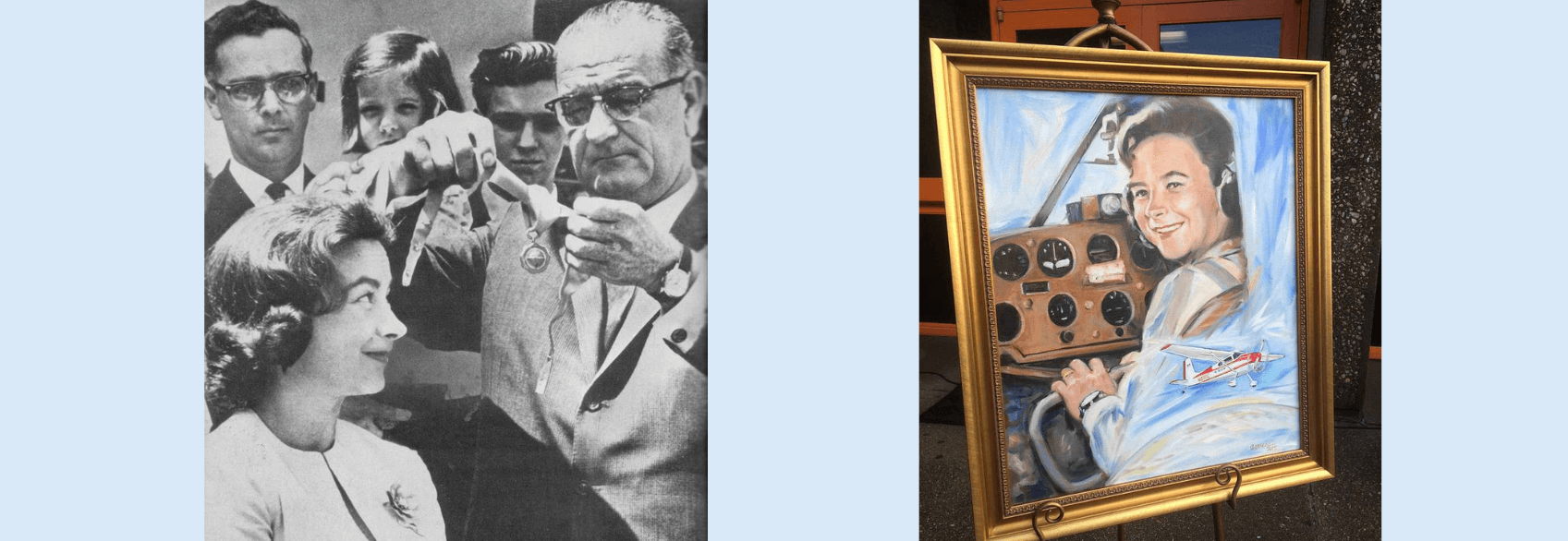
A composite of images of Jerrie Mock: (L) receiving a medal from President Lyndon Johnson, (R) in the cockpit of her airplane, Spirit of Columbus
Many collections of aviation achievements by women include Amelia Earhart who is, unfortunately, most remembered for what she did not complete in 1937: being the first female pilot to circumnavigate the world. That honor would wait until 1964 for Geraldine Mock.
Geraldine “Jerrie” Mock experienced the joys of flight as a passenger in a Ford Tri ‑motor as a child. This passion followed her to college, where she matriculates as one of the few women students of aeronautical engineering at the Ohio State University.
Mock earned her private pilot certificate in 1958 and flew regularly. The story is told of her becoming bored and looking for a challenge, to which her husband, partially joking, responded by suggesting she fly around the world. That idea stuck and, eventually, the planning began.
Mock’s Cessna 180 Skywagon, Spirit of Columbus, received a new engine, twin radio direction finders, new short‑ and long‑range radios, and a new compass. She replaced the passenger seats with fuel tanks for extra range. Much paperwork was required because, after researching, Mock was surprised that no woman had circumnavigated the globe by airplane. (As we all know, to make anything official, there will be forms.)
Mock departed on March 19, 1964, from Columbus, Ohio, and returned to Columbus on April 17, 1964. The flight took 29 days, with 21 stopovers and almost 22,860 miles.
In 1970, Mock published the story of her round‑the‑world flight in the book Three‑Eight Charlie. The book’s title references her aircraft’s tail number: N1538C. You can view this aircraft at the Smithsonian’s Udvar‑Hazy Center in Chantilly, Virginia.
Heather Penney (b. 1974)
“There are things in this world that are more important than ourselves,” she said. “[…] We belong to something greater than ourselves.”
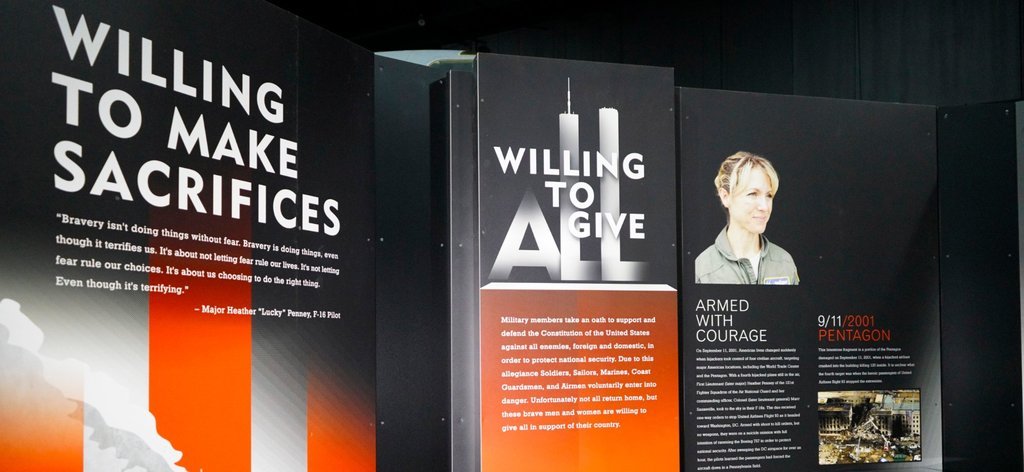
Women in the Air Force Exhibit on display in the Cold War Gallery at the National Museum of the U.S. Air Force. (U.S. Air Force photo by Ken LaRock)
Today, Heather Penney works as a defense policy expert, but she is best known for a short flight during a fearful and confusing day.
Penney was born into an Air Force family: her father was a lieutenant colonel who flew combat during the Vietnam War and later became a commercial pilot for United Airlines. Penney attended Purdue University, where she majored in literature and earned her pilot’s license.
Penney joined the United States Air Force soon after women were first allowed to fly combat missions. She remembers being the sole woman in her fighter‑pilot training class, and the only woman in her District of Columbia Air National Guard squadron at Andrews Air Force Base.
Nobody knew what was happening on September 11, 2001. Penney and her commanding officer, Marc Sasseville, were ordered to launch their Lockheed Martin F–16s to destroy the last airborne hijacked airliner, United Airlines Flight 93. (This was a time before fighters were kept fueled, armed, and ready for takeoff.) Penney and Sasseville took to the sky in their highly maneuverable, fast, and unarmed fighters with orders to down the airliner, an aircraft many times larger than theirs.
As they flew past the smoke drifting up from the damaged Pentagon, they made their plans: Sasseville would ram Flight 93 in the flightdeck, and Penney would ram its tail. One last worry that she did not think of at the time was that Penney could not have known if her father, a pilot for United, was flying Flight 93.
It never came to that—Flight 93 had already crashed before Penney and Sasseville took off, and likely would have reached Washington before they became airborne.
Years later, Penney was asked about her and Sasseville’s willingness to take on a suicide mission. “There are things in this world that are more important than ourselves,” she said. “[…] We belong to something greater than ourselves.”
Need help with aviation-related or other documents?
PAI Consulting's editors can help your organization improve the quality of your documents.
We welcome thoughtful and respectful discussion.
To keep this space safe and productive, please follow these guidelines:
Be respectful. Personal attacks, name-calling, and abusive language will not be tolerated.
Stay on topic. Keep comments relevant to the content of the post.
No spam or self-promotion. Links and promotions that are not relevant to the discussion will be removed.
Use appropriate language. This is a professional environment—please avoid profanity or offensive language.
Protect privacy. Don’t share personal information—yours or anyone else’s.
You may reply to, like, or flag other comments.
Comments are moderated and may be edited or removed at our discretion.
By commenting, you agree to abide by this policy.