
Paper Airplanes and the Long Arc of Aviation Safety
A Contemplation on National Paper Airplane Day
May 26 is National Paper Airplane Day in the United States: an unofficial celebration of the simplest flying machine most of us will ever build. It’s also the day after Memorial Day, arriving when the country is marking 250 years of American independence. These three points of reflection share a thread that weaves through aviation safety: every flying thing, from a folded sheet of notebook paper to a commercial airliner, succeeds or fails for the same reasons.
What the paper airplane already knows
Fold a piece of paper into a facsimile of an airplane and throw it across the room, and you’ll see the four forces of flight—lift, weight, thrust, and drag—doing their job. Lift held it up against gravity. Thrust pushed it forward against drag. The paper plane stayed stable because its center of gravity (weight) sat ahead of its center of lift, and because the wings produced symmetric forces on either side of the “fuselage.” If the nose tucked under, that center was too far forward; if it stalled and fluttered, too far back. If it banked sideways, one wing was bent.
Every one of those failures has a counterpart in real aircraft. In essence, the 1903 Wright Flyer was a glider with an engine added, controlled by a pilot who had spent years refining smaller designs. The Wright brothers’ notebooks read like the lab journal of someone running thousands of paper airplane trials, because that’s roughly what they were doing.
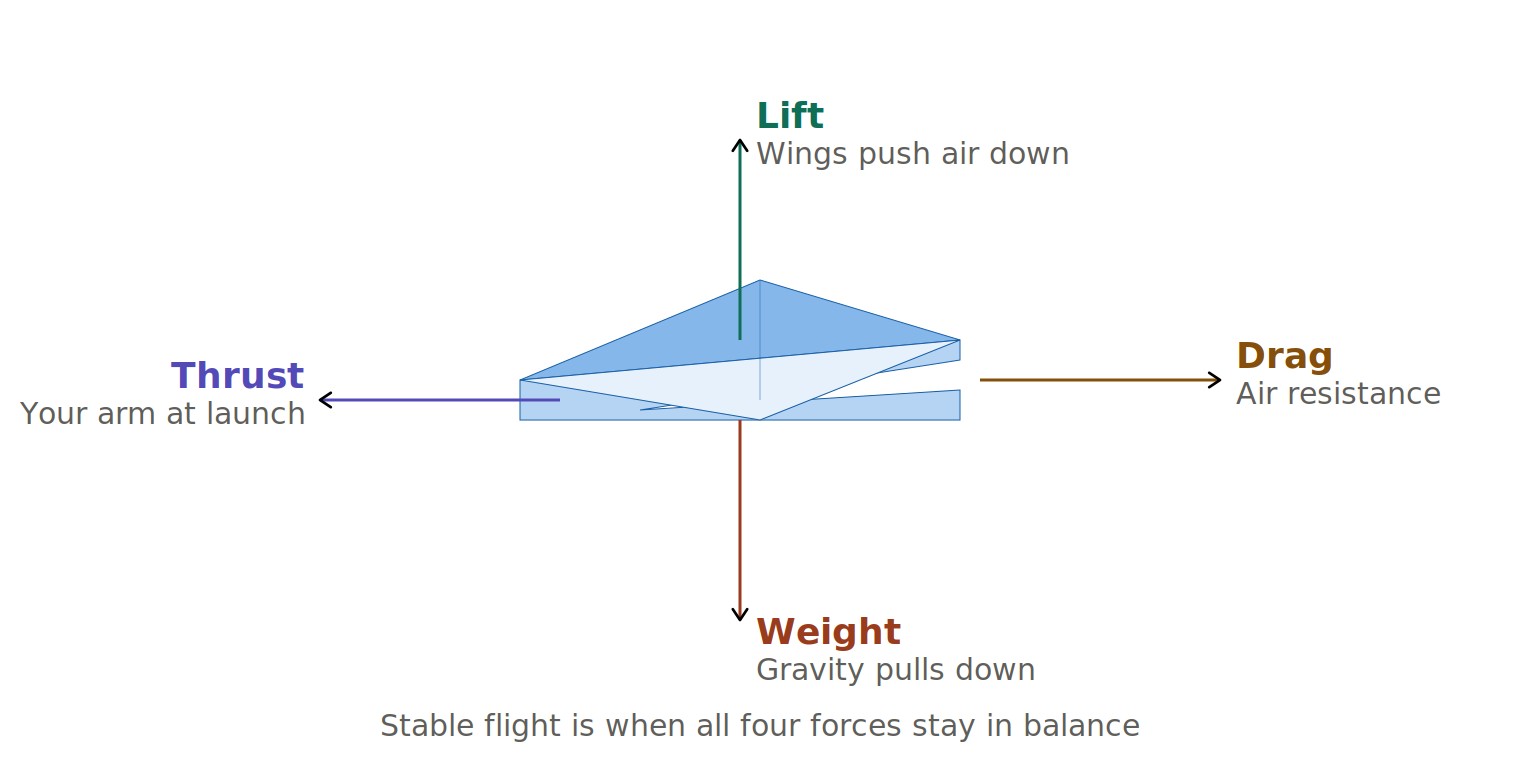
The same four forces govern a folded sheet and a commercial airliner.
The point isn’t that paper airplanes are toys: it’s that they’re the lowest‑cost, easiest‑to‑test prototype we have for a problem we’ve been working on for over a hundred years. The aerodynamics that decide whether your simple aircraft clears the cubicle wall are the same ones that govern a Boeing 787 climbing out of Dulles.
Iteration is the safety system
Here’s the part that matters for Safety Management System (SMS) practitioners: the reason a child can fold a paper airplane that flies on the first try is that the design has been explored across roughly a century of deliberate, diligent experimentation. The classic dart, the glider, the looper—these are stable designs because the unstable ones got crumpled and thrown out. Nobody wrote the crashes down.
Aviation safety works the same way, except we do write it down—we have to, because the consequences are worse than ending up in a wastebasket. Every incident report, every safety observation, every Aviation Safety Action Program (ASAP) filing is a paper airplane that didn’t fly right, plus a note about why. The SMS is the mechanism by which the industry preserves those notes and feeds them back into the design loop.
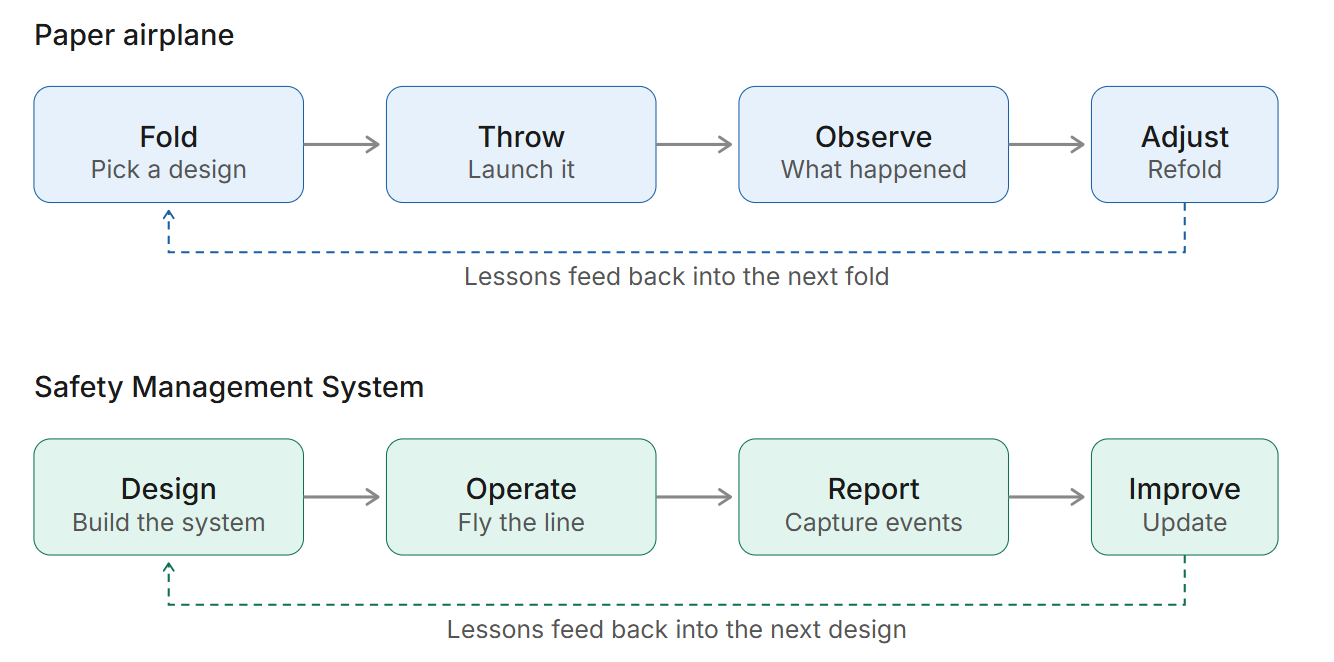
Same loop, different stakes — and SMS writes its lessons down.
This is also why documentation discipline matters so much: the Wright brothers’ real innovation wasn’t the wing warping or the engine—it was the willingness to document what worked and what didn’t.
The long view
Memorial Day reminds us that military aviation paid a steep price to learn many of the lessons civil aviation now treats as baseline. The Semiquincentennial reminds us that powered flight covers almost exactly half the United States as a country—the U.S. existed for 127 years before the Wright Flyer, and for 123 years after it. Aviation is younger than the republic by a hair, and the safety culture that surrounds it is younger still.
Try the interactive tool below: tweak a digital paper airplane’s center of gravity, throw angle, and wing dihedral, and see what happens. It’s a simplified model (real flight dynamics are vastly more complex) but the same four forces are at work, and the same lesson holds. Stable flight is not an accident but the upshot of every previous failed attempt.
Paper airplane flight simulator
Adjust the controls and press “Throw.” Find a combination that flies straight.
Paper airplane flight simulator
Adjust the controls and press throw. Find a combination that flies straight.
Happy National Paper Airplane Day! Fold a new design, throw it, and see if it flies. If it doesn’t, take notes.
Back to Stet Happens: All Things Editorial home.
Do you have questions or concerns about editorial matters? Share them with us!
PAI Consulting | Helping you succeed. Learn more.
Any opinions expressed in this article are those of the author and not the opinion of PAI Consulting. In addition, this article may contain links to third-party websites. PAI Consulting does not endorse or make any representations about them, or any information, software, or other products or materials found there, or any results that may be obtained from using them.
We welcome thoughtful and respectful discussion.
To keep this space safe and productive, please follow these guidelines:
Be respectful. Personal attacks, name-calling, and abusive language will not be tolerated.
Stay on topic. Keep comments relevant to the content of the post.
No spam or self-promotion. Links and promotions that are not relevant to the discussion will be removed.
Use appropriate language. This is a professional environment—please avoid profanity or offensive language.
Protect privacy. Don’t share personal information—yours or anyone else’s.
You may reply to, like, or flag other comments.
Comments are moderated and may be edited or removed at our discretion.
By commenting, you agree to abide by this policy.