
SMS Quick Takes - SRM in Action: A Ridgeline Air Case Study

In the most recent post in our SMS Quick Takes, we have been walking through each step of Safety Risk Management (SRM) under Title 14, Code of Federal Regulations (14 CFR) part 5, Subpart C: describing systems, identifying hazards, assessing risk, developing controls, and accepting residual risk. In this post, we bring those steps together in an example scenario to illustrate how the full SRM cycle works in practice.
Meet Ridgeline Air
Ridgeline Air is a fictional 14 CFR part 135 on‑demand charter operator, with a fleet of turboprop aircraft serving regional routes in the Pacific Northwest. Like many part 135 operators, Ridgeline has an established SMS and a safety manager who wears multiple hats. When the company decides to add a new destination—a remote airstrip with a short runway and charted terrain challenges—the safety manager knows it’s time to run a formal SRM process.
Let’s follow Ridgeline Air through each step.
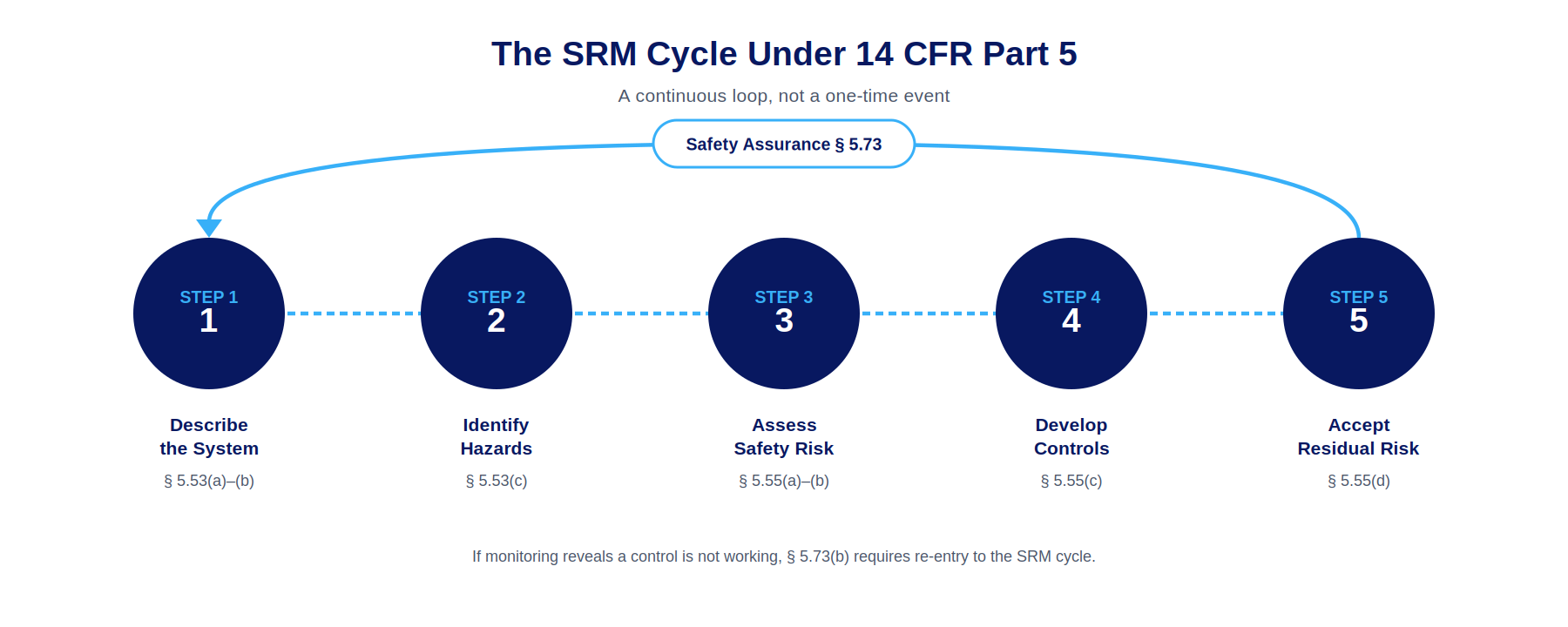
Step 1: Describe the System (§ 5.53(a)–(b))
Before identifying hazards, SRM requires a clear picture of the system being analyzed. Under § 5.53(a), Ridgeline must analyze the systems identified in § 5.51—in this case, the addition of a new destination (which triggers SRM as the implementation of a new system). § 5.53(b) specifies five elements that must be considered.
Ridgeline Air documents each:
Function and purpose (§ 5.53 (b)(1)): on‑demand passenger charter operations, route planning and dispatch, flightcrew scheduling, and ground‑handling coordination at the destination
Operating environment (§ 5.53(b)(2)): remote airstrip, 3,800‑foot runway, mountainous terrain, and variable weather (including frequent low ceilings and crosswinds)
Processes and procedures (§ 5.53(b)(3)): flight‑release and dispatch procedures, flightcrew briefing requirements, go/no‑go decision criteria, and passenger handling at a non‑staffed destination
Personnel, equipment, and facilities (§ 5.53(b)(4)): turboprop aircraft, part 135 flightcrews qualified under the existing training program, contract ground crew, destination airstrip, fixed‑base operator (FBO) fueling facility, and Ridgeline Air’s dispatch and operations center
Operational interfaces (§ 5.53(b)(5)): dispatch, maintenance, fueling (contract at the new destination), air traffic control (ATC) (limited — non‑towered field), and passengers
This system description becomes the foundation for everything that follows; without it, Ridgeline risks an incomplete hazard identification.
Step 2: Identify Hazards (§ 5.53(c))
Under § 5.53(c), operators must develop and maintain processes to identify hazards within the context of the system analysis. Part 5, § 5.3 defines a hazard as “a condition or an object that could foreseeably cause or contribute to an incident or aircraft accident.” The emphasis in § 5.53(c) is on process: hazard identification is not a one‑time brainstorm, but a repeatable, documented method tied to the system description completed in Step 1.
With the system described, Ridgeline’s safety manager works with dispatch, the chief pilot, and a line crew member to conduct a structured hazard‑identification session, working through each element of the system analysis and asking what could go wrong at each point under typical or abnormal operational conditions.
The team identifies several hazards, including:
Short runway with limited go‑around margin in mountainous terrain,
Unreliable weather reporting at the destination (no automated reporting available),
Unfamiliar contract‑fueling provider with unknown quality‑control processes, and
Flightcrew unfamiliarity with the new route, terrain, and non‑towered traffic environment specific to that airport.
Each hazard is documented in Ridgeline Air’s hazard registry with a unique identifier, the date it was identified, and the team member who raised it. Tying each hazard back to the system element that discovered it ensures the analysis remains grounded in the system description, required by § 5.53(c).
Step 3: Assess Safety Risk (§ 5.55(a)–(b))
With hazards identified, Ridgeline applies its documented risk assessment process under § 5.55(a)–(b). Section 5.55(a) requires developing and maintaining processes to analyze safety risk associated with identified hazards; § 5.55(b) requires defining a process allowing for the determination of acceptable safety risk. Using the organization’s risk matrix, calibrated for likelihood and severity per Advisory Circular (AC) 120–92D, Safety Management Systems for Aviation Service Providers, the team evaluates each hazard.
An important distinction from AC 120–92D: likelihood and severity are assessed for the potential occurrence, the accident or incident, not for the hazard itself. This keeps the analysis focused on realistic outcomes rather than abstract conditions.
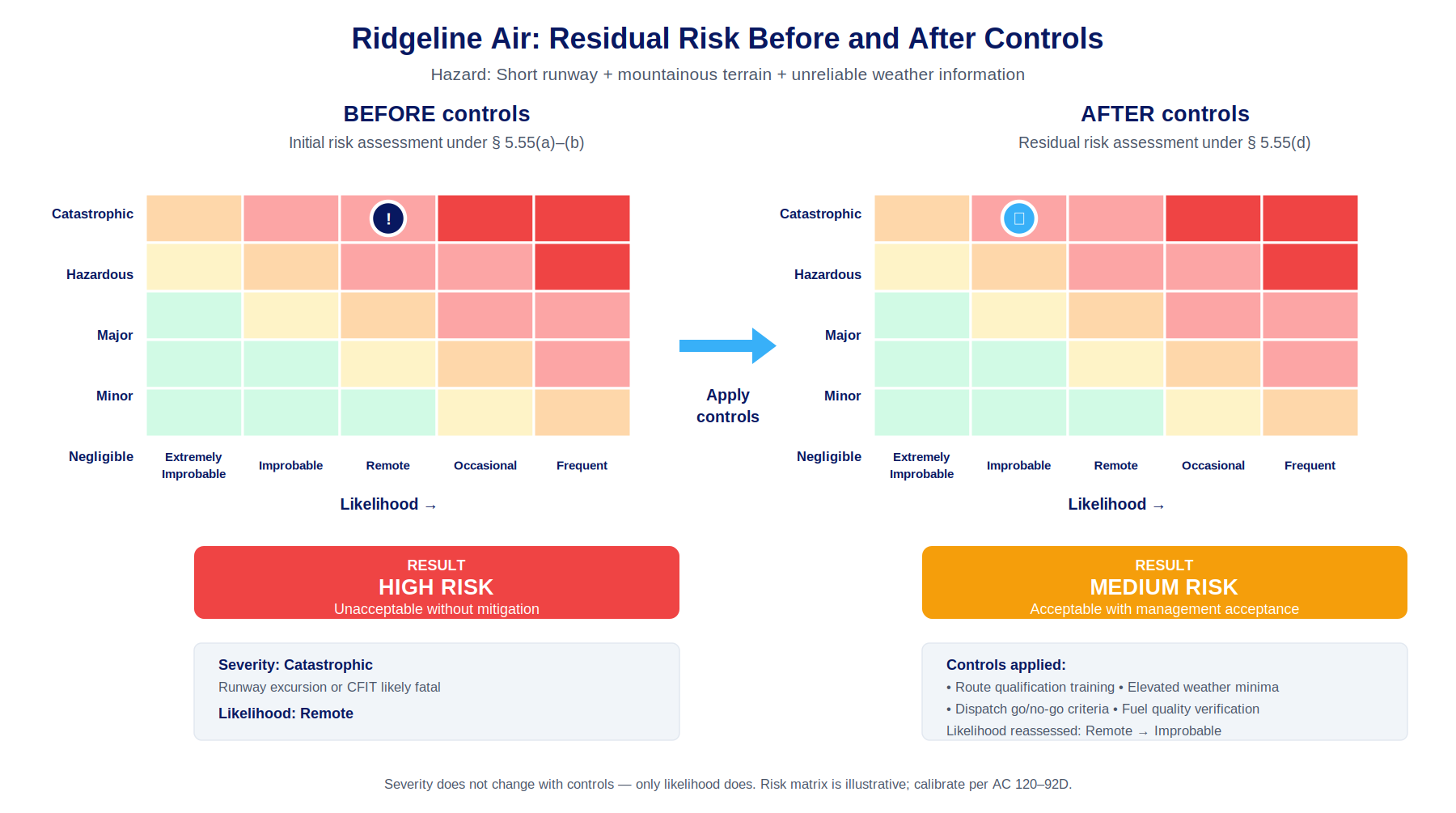
For this scenario, we will focus on the highest‑rated hazard: the combination of a short runway, mountainous terrain, and unreliable weather information. The team assesses:
Severity: Catastrophic. A runway excursion or controlled flight into terrain (CFIT) event at this location would likely be fatal.
Likelihood: Remote. Experienced flightcrews with proper preparation are unlikely to encounter this scenario, but the combination of factors elevates exposure compared to Ridgeline’s existing routes
Using Ridgeline’s risk matrix, this hazard is assessed as High Risk; therefore, unacceptable without mitigation.
Step 4: Develop Risk Controls (§ 5.55(c)–(d))
Under § 5.55(c), Ridgeline Air must develop and maintain processes to identify controls necessary resulting from the risk assessment. AC 120–92D stresses effective controls are clearly assigned, documented, and proportional to the risk. Importantly, § 5.55(d) requires residual risk be acceptable with the proposed safety risk control applied before the control is implemented.
Ridgeline Air develops the following controls:
Route qualification training: all flightcrews assigned to the new route must complete a route‑familiarization training program covering terrain, traffic patterns, and non‑standard procedures for the destination airstrip, before their first revenue flight.
Weather minima: Ridgeline Air establishes company‑specific weather minima for the destination that exceed Federal Aviation Regulation (FAR) minimums, accounting for the limited weather reporting and terrain exposure.
Dispatch go/no‑go criteria: dispatch adds the new destination to Ridgeline’s operational risk assessment checklist, with specific go/no‑go triggers tied to weather, Notice to Air Missions (NOTAM) review, and fuel availability confirmation.
Fuel quality verification: the safety manager contacts the contract‑fueling provider and obtains documentation of their fuel quality‑control program. A formal supplier evaluation is added to Ridgeline’s SMS interface process.
Finally, each control is documented in the hazard registry, assigned to a responsible party, and includes a targeted implementation date.
Step 5: Evaluate Residual Risk and Accept (§ 5.55(d))
With controls defined, Ridgeline Air re‑reapplies the risk matrix under § 5.55(d) to evaluate residual risk; that is, the remaining risk with the proposed controls applied, before those controls are put into operation.
With the route qualification program, elevated weather minima, and enhanced dispatch criteria in place, the team reassesses likelihood: the combination of trained flightcrews, conservative weather limits, and structured dispatch review is expected to significantly reduce exposure. The team reassesses likelihood as Improbable, which, when combined with the Catastrophic severity, produces a residual risk level of Medium Risk on Ridgeline Air’s matrix.
Ridgeline’s SMS manual defines Medium Risk as acceptable with documented management acceptance. Consistent with AC 120–92D guidance, risk‑acceptance decisions must involve personnel with the authority to make them, so the director of operations, who holds authority over flight‑operations decisions under Ridgeline’s SMS, reviews and formally accepts the residual risk, signing the hazard‑registry entry as required under § 5.55(d). The acceptance is then dated and filed.
Importantly, this acceptance does not close the file—it opens the door to the next phase.
The Handoff to Safety Assurance
Accepting residual risk is not the end of the SRM process: it is the beginning of safety assurance. Under § 5.73(a)(3), Ridgeline Air is now obligated to evaluate the effectiveness of the controls it just implemented. The safety manager establishes monitoring actions tied to each control:
Route‑qualification training completion rates are tracked in the training records system,
Weather‑related diversions or cancellations from the new destination are flagged for trend review, and
Fuel‑quality documentation from the contract provider is reviewed at each annual supplier evaluation.
If monitoring reveals a control is not working as intended (for example, if flightcrews begin requesting exceptions to the weather minima), § 5.73(b) requires Ridgeline to re‑ reenter the SRM process. Per Ridgeline’s documented process, the safety manager updates the hazard registry and works with the team to identify corrective action under § 5.75.
This is the loop that makes SMS a living system, rather than a compliance exercise.
The Full SRM Cycle at a Glance
Ridgeline Air, a fictional Part 135 charter operator, applied under 14 CFR Part 5
Describe the system
§ 5.53(a)–(b)
What Ridgeline Air did
Documented all five § 5.53(b) elements: function and purpose, operating environment, processes and procedures, personnel/equipment/facilities, and interfaces
Identify hazards
§ 5.53(c)
What Ridgeline Air did
Cross functional team session structured around system analysis elements; four hazards documented in hazard registry
Assess safety risk
§ 5.55(a)–(b)
What Ridgeline Air did
Applied risk matrix; primary hazard rated High Risk (Catastrophic severity, Remote likelihood)
Develop risk controls
§ 5.55(c)
What Ridgeline Air did
Four controls assigned with responsible parties and target implementation dates
Evaluate residual risk and accept
§ 5.55(d)
What Ridgeline Air did
Residual risk reduced to Medium Risk; formally accepted by director of operations before implementation
Monitor under safety assurance
§ 5.73, § 5.75
What Ridgeline Air did
Monitoring actions established for each control; re entry to SRM required if controls prove ineffective
SRM Cycle Walkthrough: Ridgeline Air
A fictional Part 135 charter operator working the full cycle under 14 CFR Part 5
Ridgeline Air is a fictional operator created for illustrative purposes. Any resemblance to actual operators is coincidental and unintended. The SRM process shown here is consistent with part 5, AC 120–92D, and International Civil Aviation Organization (ICAO) Doc 9859 guidance.
We welcome thoughtful and respectful discussion.
To keep this space safe and productive, please follow these guidelines:
Be respectful. Personal attacks, name-calling, and abusive language will not be tolerated.
Stay on topic. Keep comments relevant to the content of the post.
No spam or self-promotion. Links and promotions that are not relevant to the discussion will be removed.
Use appropriate language. This is a professional environment—please avoid profanity or offensive language.
Protect privacy. Don’t share personal information—yours or anyone else’s.
You may reply to, like, or flag other comments.
Comments are moderated and may be edited or removed at our discretion.
By commenting, you agree to abide by this policy.