
Choosing the Right Meeting Location
Finding the right venue for your next meeting can be vital to how productive and successful your event will be. Whether you are organizing a weekly team session, an annual offsite conference, or a large hybrid meeting, the setting can influence how attendees communicate, collaborate, and concentrate. In this blog post, we will discuss how to choose the most appropriate settings for your next meeting.
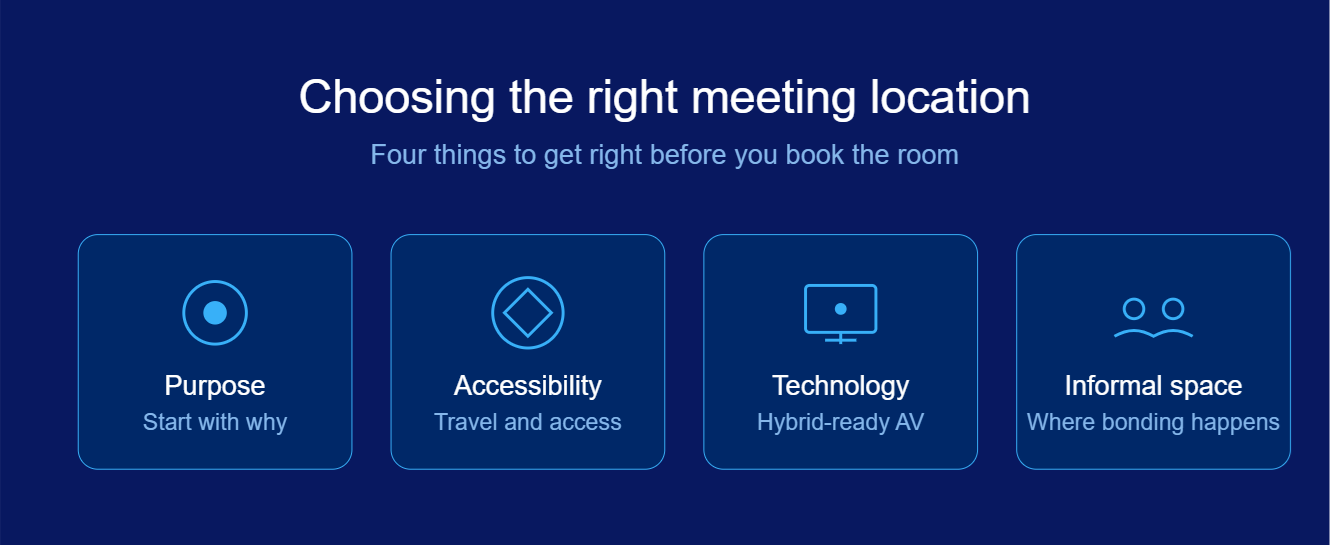
Start With the Purpose, Not the Place
Before browsing available venues, it is important to understand your meeting’s purpose: is it to, for example, foster deep collaboration, provide project status updates, or to simply build relationships across teams?
For deep collaboration sessions, consider searching for spaces designed for interaction and that include breakout rooms or flexible layouts.
For status updates, consider a room with minimal distractions, and the appropriate tech infrastructure to support the necessary presentations.
For relationship‑building gatherings, consider a more relaxed, open area.
When the purpose is clear, you can narrow your venue search to ensure it will only enhance the meeting experience.
Consider Accessibility
Fairness and convenience are key to ensuring as many attendees as possible can participate in your meeting—especially if they are spread across regions.
Consider travel times and costs. Aim for locations that minimize the burden of travel as much as you can for the entire group—a good rule of thumb is to rotate through different geographic locations to maintain fairness.
Ensure there are various transportation options nearby. Hosting a meeting near transportation hubs, such as cities with major airports and ground transportation options, is always a safe bet. This is especially important for international attendees, who have the extra burden of considering visa or entry requirements.
Confirm the location is accessible to all attendees. That may mean having to confirm the location is Americans with Disabilities Act (ADA)‑compliant, or simply ensuring parking is convenient.
Plan for Technology Needs
This is particularly important if you are hosting a hybrid meeting: you want remote attendees to have the same seamless experience as the in‑person ones. Make sure to consider whether the location has high‑speed, reliable internet and operational audiovisual (AV) equipment, such as cameras, microphones, and screens.
Spaces Beyond the Meeting Room
Another aspect to think about when choosing the right location is the space beyond the meeting room itself. Especially during full‑day meetings, attendees tend to socialize and network during breaks; sometimes valuable conversations outside of the agenda happen during these breaks, as well. Consider locations with—
Informal open spaces, such as lounges or lobbies.
Outdoor spaces: gardens, walking paths, etc.
Cafes, libraries, or other attractions that are walkable from the primary location.
These extra spaces can often bring attendees together in a less formal and strict manner, fostering better working relationships.
Ultimately, choosing the right meeting location can set the stage for more productive and successful events. By considering your purpose, accessibility needs, technology requirements, and extra informal spaces, you can create an environment that will support your goals instead of hindering them. Now that you have the tips for picking a perfect location, check out How to Create an Effective Meeting Agenda to further maximize your meeting’s success!
Meeting Venue Fit Check
Answer four quick questions to generate a tailored venue checklist for your next meeting.
Your venue checklist
We welcome thoughtful and respectful discussion.
To keep this space safe and productive, please follow these guidelines:
Be respectful. Personal attacks, name-calling, and abusive language will not be tolerated.
Stay on topic. Keep comments relevant to the content of the post.
No spam or self-promotion. Links and promotions that are not relevant to the discussion will be removed.
Use appropriate language. This is a professional environment—please avoid profanity or offensive language.
Protect privacy. Don’t share personal information—yours or anyone else’s.
You may reply to, like, or flag other comments.
Comments are moderated and may be edited or removed at our discretion.
By commenting, you agree to abide by this policy.